![[Translate to English:]](/storages/zentraler_bilderpool/_processed_/f/5/csm_Audimax_Vorlesung-2_c73aa312b4.jpg "[Translate to English:]")
B.Sc. in Logistics
At a Glance
Standard duration of study:
7 semesters in full-time
Scope and Content
210 ECTS, refer to the module handbook
Language
German, partly English
Start of study
Wintersemester
Admission Requirements
HZB or other qualification pursuant to §49 HG
Industrial internship
12-week specialized internship
Basic internship no longer required starting in the winter semester of 26/27
Study Abroad Program
Optional during the 5th/6th semester
Registration Deadline
by Friday before the start of lectures of the WS
Logistics keeps the world moving. The Logistics program at TU Dortmund University focuses on the planning, management, and optimization of material, financial, and information flows within value-added systems and networks. The goal is to design complex logistics processes in an efficient, sustainable, and future-proof manner.
As an interdisciplinary field, logistics combines elements of engineering, economics, and computer science. Through its close integration of computer science, the program specifically addresses the increasing digitization of logistics systems—for example, through data-driven processes, digital platforms, and intelligent networking along value chains.
At the beginning of the program, a structured orientation phase helps you get started. Introductory modules and trial courses help you become familiar with the program’s requirements and gradually adapt to academic work at the university.
During the program, you will learn to view logistics systems holistically and to think beyond the boundaries of individual companies and departments. The focus is on performance and cost aspects as well as sustainability issues. The goal of logistics planning is to provide materials and information in the right quantity, at the right time, in the right place, and of the right quality—as efficiently as possible and with minimal impact on the environment and resources.
In addition, you’ll have the opportunity to gain international experience and complete parts of your studies abroad. This will not only broaden your professional horizons but also help you develop valuable intercultural skills for a globally interconnected economy.
To review and supplement your math skills, we recommend the Introductory Math Course. This 3-week course is offered every year in September.
A total of 12 weeks of specialized industrial internship is required. The 8-week basic internship will no longer be required starting in the winter semester of 26/27. For more information, please visit the Internship Office website.
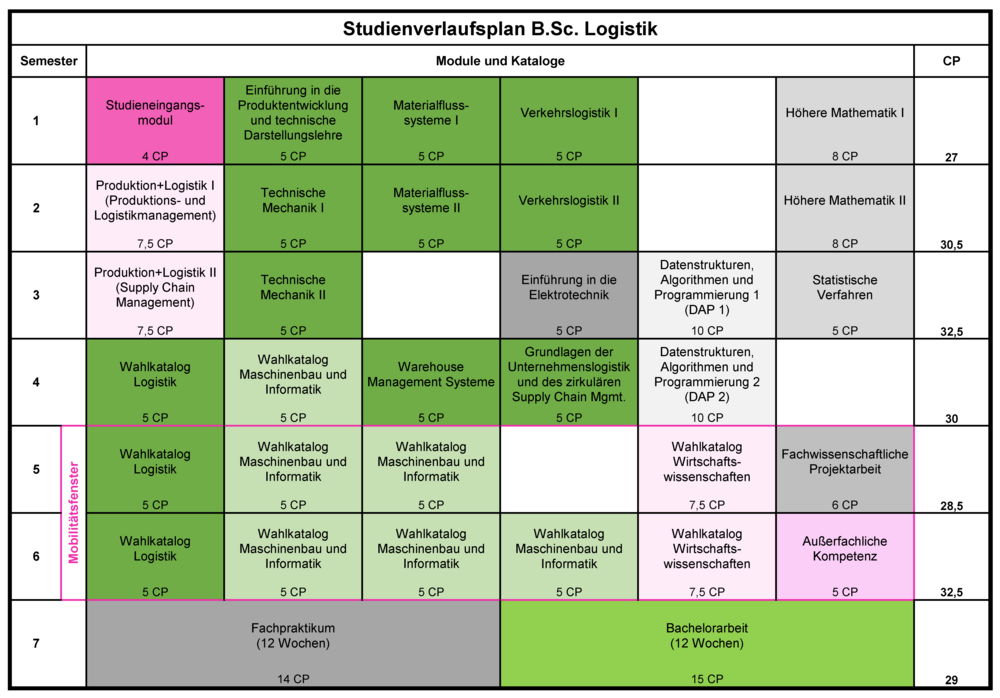
The bachelor’s program in Logistics at TU Dortmund University is a full-time program lasting seven semesters, with the seventh semester devoted to an internship and the completion of the bachelor’s thesis.
The teaching of logistics content begins in the first semester and is conducted within the context of current findings in engineering, economics, and the natural sciences.
From the very beginning, the bachelor’s program covers all facets of logistics. This is achieved primarily through courses on transportation, intra-company, corporate, and information logistics, as well as the fundamentals of supply chain management. In parallel, the curriculum includes foundational knowledge in mechanical engineering, electrical engineering, computer science, and economics.
In the later semesters, students have the opportunity to gain more in-depth knowledge in the areas of intralogistics, transportation, and simulation (planning) through elective courses. Similarly, students select advanced economics courses individually and according to their needs.
In addition to imparting broad-based subject and methodological knowledge, courses designed to develop social and practical skills are an integral part of the program.
Additional qualifications and industry internships totaling 20 weeks further round out your specialized knowledge and facilitate its application in a professional setting.
Study Plan for the 2026 Academic Year
Module Handbooks and Examination Regulations
The module handbook describes the content, learning objectives, and assessment requirements for each course. The examination regulations establish the legal framework for the degree program.
Module Handbook PO 2026
Applies to all students who began their studies in the 26/27 winter semester or later, and to all students who switched from the 2019 curriculum to the 2026 curriculum
PO 2019 Module Handbook
Includes the 2019 Academic Plan for Part-Time Students
Examination Regulations
Examination Regulations for the Bachelor's Degree in Logistics