![[Translate to English:]](/storages/zentraler_bilderpool/_processed_/f/5/csm_Audimax_Vorlesung-2_c73aa312b4.jpg "[Translate to English:]")
M.Sc. in Industrial Engineering
At a Glance
Standard duration of study
3 semesters full-time
5 semester part time
Scope and Content
90 ECTS; see the module handbook
Language
German, partly English
Start of Study
summer and winter semesters
Admission Requirements
Equivalent bachelor's degree
Industrial Internship
not required
Study Abroad
optional in the 1st or 2nd semester
Application
Anytime (international applications due by Jan. 15 or July 15)
The master’s program in Industrial Engineering at TU Dortmund University deepens the knowledge you acquired during your bachelor’s studies at the intersection of engineering and business.
Through the close collaboration between the departments of Mechanical Engineering, Electrical Engineering and Information Technology, and Economics, you will gain an interdisciplinary understanding of technical, economic, and organizational issues. At the same time, the program’s academic focus provides a solid foundation for pursuing a doctoral degree.
During the program, you’ll have the opportunity to set individual areas of focus and develop your professional profile in a targeted manner . In addition to established specializations such as Industrial Management, Management of Electrical Systems, and Production Management, you can also delve deeper into current, forward-looking topics such as circular value chain management.
Furthermore, the program opens up international opportunities. You have the option to complete parts of your studies abroad and to enrich your academic experience through international exposure and courses taught in English.
Graduates of the Master’s program in Industrial Engineering are highly versatile thanks to their interdisciplinary training. They are particularly in demand in fields where technical development and business decisions converge—such as at the intersection of design, production, and management.
Admission requirements are governed by the examination regulations. The self-assessment guide explains the requirements for the preceding bachelor’s degree. The admission requirements represent the minimum standards.
The Master of Science in Industrial Engineering builds upon the knowledge gained during the bachelor’s program in the fields of mechanical engineering, electrical engineering, and economics, and, through its academic focus, also prepares students for a doctoral degree. The admission requirements are governed by the examination regulations.
The Master’s program focuses on academic research. Lectures by external instructors, as well as the teaching and application of skills in cooperation with industry partners, ensure the practical relevance of the application-oriented content. An industry internship is not mandatory but may be completed on a voluntary basis.
The Master of Science in Industrial Engineering builds on the knowledge gained during the bachelor’s program in the fields of mechanical engineering, electrical engineering, and economics, and—thanks to its research-oriented focus—also prepares students for doctoral studies.
During the program, you will have the opportunity to choose individual areas of focus and further develop your professional profile in a targeted manner . Students can specialize in the following four specializations :
- Production Management
- Circular Value Chain Management
- Management of Electrical Systems
- Industrial Management
Depending on the specialization, students have the opportunity to delve deeper into their personal areas of interest and thereby prepare specifically for careers in production planning, the energy sector, or business administration—including in an international context.
This specialization promises a high success rate for job applications in the relevant industrial sectors.
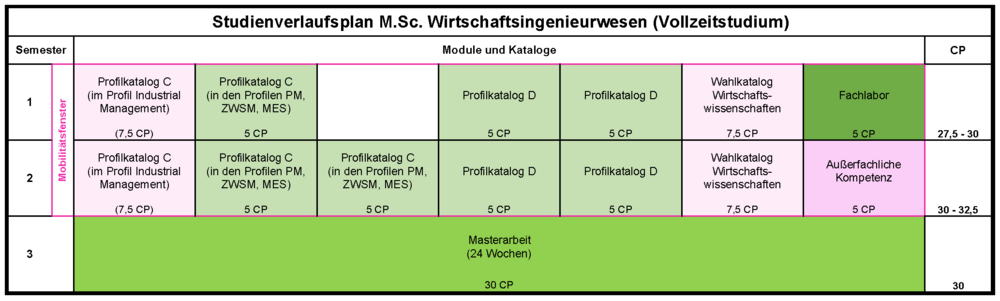
Study Plan for the 2026 Graduate Program
Profiles
Tailor your degree program to your interests: A wide range of elective courses allows you to set your own priorities. You can choose from the following four tracks:
Module Handbooks and Examination Regulations
The module handbook describes the content, learning objectives, and assessment requirements for each course. The examination regulations establish the legal framework for the degree program.
Module Manual PO 2026
Applies to all students who began their studies in the winter semester of 26/27 or later, and to all students who switched from the 2019 study plan to the 2026 study plan
PO 2019 Module Handbook
Includes the 2019 academic program plan
Examination Regulations
Examination Regulations for the Master's Program in Industrial Engineering
Job & Master's - Combining Studies and Work
Job or Master’s degree? You can do both!
Learn more about the options for structuring your studies flexibly so you can combine them with a job. The study plan for the part-time track provides guidance for planning your studies, which have a standard duration of 5 semesters.
