![[Translate to English:]](/storages/zentraler_bilderpool/_processed_/f/5/csm_Audimax_Vorlesung-2_c73aa312b4.jpg "[Translate to English:]")
M.Sc. in Logistics
At a Glance
Standard duration of study
3 semesters full-time
5 semesters part-time
Scope and Content
90 ECTS, refer to the module handbook
Language
German, partly English
Start of Study
summer and winter semesters
Admission Requirements
Equivalent bachelor's degree
Industrial Internship
not required
Study Abroad
optional during the 1st/2nd semester
Application
Anytime (international applications due by Jan. 15 or July 15)
Rethinking Logistics: Combining Technology, Digitalization, and Intelligent Systems. With its reorientation for the 2026–27 winter semester, TU Dortmund University is also bringing fresh momentum to logistics education through its Master’s program in Logistics.
The Master’s program in Logistics combines proven logistics expertise with forward-looking content from mechanical engineering and computer science. This creates a modern academic profile at the intersection of technology, digitalization, and intelligent systems.
The logistics of the future emerges where physical processes, digital technologies, and innovative technical solutions interact. The newly restructured Master’s program in Logistics at TU Dortmund University prepares students to analyze, further develop, and design sustainable complex systems, and to meet the challenges of an increasingly digitized and automated logistics sector.
The Master’s in Logistics at TU Dortmund University represents a new generation of logistics: technically sound, digitally connected, and practice-oriented.
Studying at Europe's Logistics Hub
As one of Europe’s leading logistics and technology hubs, Dortmund offers an ideal environment for a practice-oriented master’s program. The connection between the university, research, and industry provides insights into current developments and creates a wide range of opportunities for projects, networking, and career paths. You’ll benefit from the immediate proximity to the Fraunhofer Institute for Material Flow and Logistics (IML), one of the world’s leading research institutes in the field of logistics.
Its central location in the Ruhr region places you in close proximity to numerous companies, research institutions, and innovative logistics projects. At the same time, Dortmund stands out as a university city with short distances, a wide range of recreational activities, good infrastructure, and attractive housing.
Benefits at a Glance:
- Interdisciplinary master’s program combining logistics, mechanical engineering, and computer science
- New technical focus on digitalization, automation, and intelligent systems
- Opportunities for individualized specialization and personal focus
- Practical projects with industry partners
- Study at one of Europe’s leading logistics hubs
- Excellent career prospects in industry, consulting, and research
- An attractive student life in Dortmund with a good value for money, a wide range of housing options, and an international environment
Admission requirements are governed by the examination regulations. The self-assessment guide explains the requirements for the preceding bachelor’s degree. The admission requirements represent the minimum standards.
The courses in the master’s program build upon the knowledge gained in the bachelor’s program—particularly in the areas of physical logistics, information logistics, and logistics management. They promote systemic and networked thinking, impart in-depth methodological knowledge, and lay the foundation for a scientific approach to work.
The Master’s program focuses on academic research. Lectures by external instructors, as well as the teaching and application of skills in cooperation with industry partners, ensure the practical relevance of the application-oriented content. An industry internship is not mandatory but may be completed on a voluntary basis.
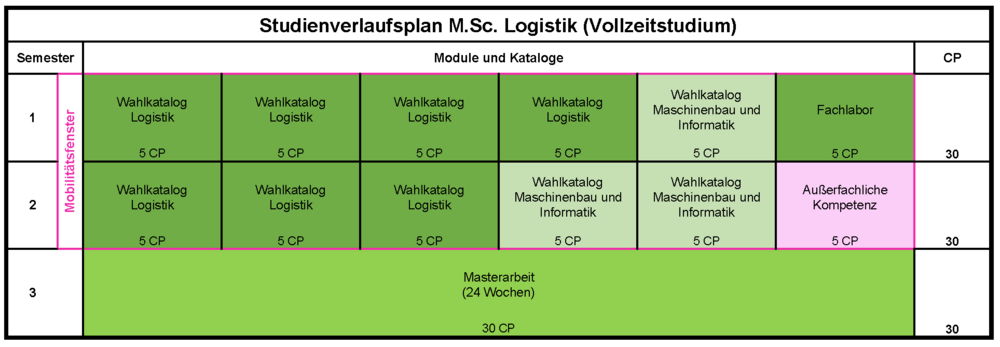
This three-semester full-time program builds on the knowledge gained in the bachelor’s program and provides in-depth study, particularly in the areas of physical logistics, information logistics, and logistics management. These topics are supplemented by technical and digital specializations that allow for individual customization.
The elective options in mechanical engineering and computer science allow students to develop a personalized skill set that meets the diverse demands of modern industry and research fields. Students can pursue their interests in a targeted manner—from intelligent production systems to automation and data analysis, all the way to digital logistics solutions.
Particular emphasis is placed on scientific research and the development of original solutions. Specialized labs, project work, simulation exercises, and collaboration with industry partners combine theoretical knowledge with practical application. In the process, you will learn to make well-founded strategic and operational decisions for complex systems.
Study Plan for the 2026 Intake
Module Handbooks and Examination Regulations
The module handbook describes the content, learning objectives, and assessment requirements for each course. The examination regulations establish the legal framework for the degree program.
Module Manual PO 2026
Applies to all students who began their studies in the winter semester of 2026/27 or later, and to all students who switched from the 2019 curriculum to the 2026 curriculum
PO 2019 Module Handbook
Includes the 2019 Academic Plan for Undergraduate Students
Examination Regulations
Examination Regulations for the Master's Program in Logistics
Job & Master—Combining School and Work
Job or Master’s Degree? You Can Do Both!
Learn more about the options for structuring your studies flexibly so you can combine them with a job. The study plan for the part-time program provides guidance for planning your studies, with a standard duration of 5 semesters.
